
Sancta Birgitta Klostermuseum
Tidens rum (The Room of Time)
Sancta Birgitta Klostermuseum
Tidens rum (The Room of Time)


The Sancta Birgitta Klostermuseum is a historical museum with an emphasis on the Middle Ages and the cultural heritage left by St. Birgitta. The museum is located in the building where many of our stories take place, starting in the palace that Birger Jarl had built for his son Valdemar in the 1260s.
The feasts of the knights' age are turned into the monastic life of the Bridgettine Order. It is a rich story that takes us on a journey through time, through a war invalids' home, mental hospitals, and now a museum.
Opening hours 2026
January: Saturday–Sunday 11–17.
Christmas holidays (2–4 January): Friday–Sunday 11–17.
February: Saturday–Sunday 11–17.
Winter school holidays (14–22 February): Daily 11–17.
March: Saturday 11–17.
April/May: Thursday–Sunday 11–17.
1 June – 30 August: Daily 11–17.
Midsummer Eve (Friday 19 June) closed.
September: Thursday–Sunday 11–17.
October–December: Saturday–Sunday 11–17.
Autumn school holidays (24–31 October): Daily 11–17.
Christmas holidays (26–27 December): Friday/Saturday 11–17.
Guided theme tours (in Swedish) on all open days at 12 and 15.
Guided tours
Guided theme tours on all open days at 12 and 15.
The museum's knowledgeable guides will take you on a journey through Swedish history from Birger Jarl's 13th century to Swedish women's suffrage and all the way to how St. Birgitta can inspire us today.
Themed tours can be booked in Salver, and if space is available, tickets can be purchased at the museum shortly before the tour.
The museum is open for bookings all year round.
Museum admission
Adults: 110 SEK.
Children and teens (up to 17): Free
Museum admission and guided theme tour
Adults: 160 SEK.
Children and teens (8–17): 50 SEK.
Museum admission and family tour
Adults: 110 SEK.
Children and teens (8–17): 50 SEK.
The Heritage Card (Kulturarvskortet) gives you half price on admission.
Contact
+46-143-100 31

Vadstena Castle was built in 1545–55 originally as a fortress by King Gustav Vasa to protect the country from possible Danish and Smålandish attacks. Soon after, reconstruction into a habitable castle began when Prince Magnus became Duke of Östergötland. By 1620, Vadstena Castle was completed and is today regarded as one of Sweden’s best-preserved Renaissance castles.
Visitors can enjoy the castle alone or take one of the exciting guided tours.
Opening times 2026
14–22 February (Winter school holidays): Daily 12–16
23–28 February: Saturday 12–16
1 March – 1 April: Daily 12–16
2–12 April (Easter school holidays): Daily 11–16
13 April – 21 June: Daily 11–16
22 June – 3 July: Daily 10–18
4–5 July: Medieval days!
6 July – 16 August: Daily 10–18
17 August – 4 October: Daily 11–16
5 October – 1 November: Daily 12–16
2–26 November: Saturday & Sunday 12–16
27–29 November: Christmas market
30 November – 20 December: Saturday 12–16
26–30 December, 2–6 January (Christmas school holidays): Daily 12–16
Admission:
Adults: 110 SEK
Pensioners & Students (ID required): 100 SEK
Children (7–17): 80 SEK
Children under 7: free (school holiday activity 20 SEK)
With the Kulturarvscard (Cultural Heritage Card) you pay half the admission price.
Other prices apply for entry with guided tours.
Contact
+46-143-62 16 00

At the National Archives, you can explore Sweden’s written cultural heritage and receive assistance in accessing information from the archives. You can also view exhibitions, listen to lectures, or join a guided tour. Since 1899, the Regional State Archives in Vadstena have held state archives, which contain, for example, records of births, marriages, and deaths, estate inventories, title deeds, criminal records, and maps. The largest archive is that of the Göta Court of Appeal, which is a full 5.5 km long. Some of this private archival treasure has also found its way into the National Archives, for example from castles, estates, companies, and associations.
The National Archives for the counties of Jönköping, Kalmar, Kronoberg, and Östergötland are housed in Vadstena Castle. With a few minor exceptions, all the National Archives’ collections are available for research. The exceptions apply to government archives where disclosure must first be assessed against the provisions of the Secrecy Act. In addition, there are certain private archives where the depositor has set conditions regarding access to the archives.
Opening times
Monday: 10:00 – 16:00
Tuesday: 10:00 – 19:00
Wednesday: 10:00 – 16:00
Thursday: 10:00 – 16:00
Friday: Closed
Summer opening times (June–August)
Monday: Closed
Tuesday: 10:00 – 16:00
Wednesday: 10:00 – 16:00
Thursday: 10:00 – 16:00
Friday: Closed
Exceptional opening hours
The reading room is closed on public holidays, Midsummer’s Eve, Christmas Eve and New Year’s Eve.
Current exhibition:

Jewish Life in Östergötland and Småland – The Archives Tell the Story
Based on archival documents, this exhibition depicts Jewish community life and entrepreneurship in Östergötland and
Småland during the 18th, 19th and 20th centuries.


In 2022, a new and very interesting exhibition about 19th-century Vadstena opened. The exhibition "A Half-Sized Small Town" takes us back to 19th-century Vadstena, where we meet both (sometimes disappointed) visitors and the entertainment life of the time. In the newly decorated salon, the memory of the Holm family lives on and the drawings of Mayor Öhrström have, as always, a prominent place.


Opening times 2026
The museum is mainly open during the summer, but is also open for special events. Free admission.
Summer opening times 2026
Daily 21 June - 16 August 13.00 - 16.00: Free admission!
Discrepancies may occur.
Extra opening times and group tours can be arranged by agreement.
Contact or call +46-10-476 87 31.
Welcome to Vadstena Town Museum
(PDF, in English)
www.vadstenastadsmuseum.se
(English)

The Museum of the History of Medicine had been housed in the so-called ‘Stora Dårhuset’ (the ‘Great Madhouse’), built in 1757, since 1977, right in the heart of the old hospital grounds. Here, the development of psychiatry over the centuries was depicted, from Mårten Skinnare’s hospital to Birgitta’s hospital in the post-war period.
The building, which is of cultural and historical significance, no longer meets the requirements for a museum, which is why the exhibition has been closed and the building cleared. Östergötland Museum intends to reopen it at a different location. However, it is unclear when and where this will happen.
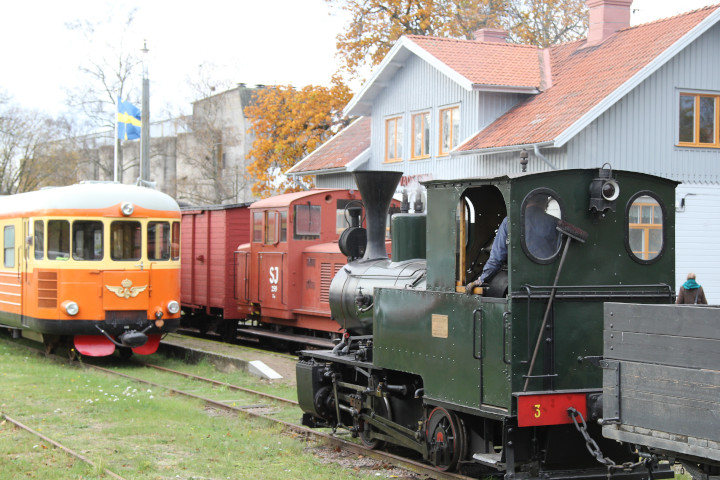
Welcome to Vadstena and the Wadstena-Fogelsta Railway.

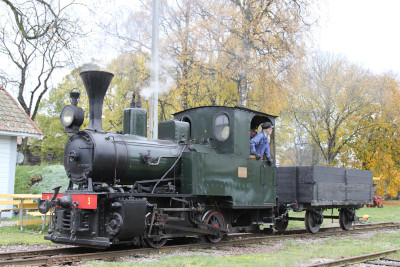
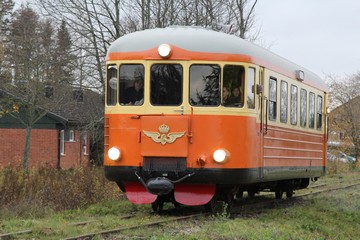
The Vadstena-Fogelsta Railway (WFJ) opened in October 1874. WFJ was one of the first two narrow-gauge lines in Östergötland. The 9.6 km long track was funded by Vadstena town and was built to provide access to the standard-gauge lines and the privately owned Hallsberg-Motala-Mjölby railway, which was inaugurated one year previously in 1873. Today, visitors can ride vintage trains from Vadstena station during the summer months, lasting 20-25 minutes.
Traffic days 2026
Saturdays 1 July - 1 August, 22 August
13:00, 14:00, 15:00, 16:00.
Sundays 2 July - 2 August, 23 August
Departures 13:00, 14:00, 15:00, 16:00.
Wednesday 12 August (Nostalgia evenening)
Departures 17:00, 18:00, 19:00, 20:00.
Saturday 12 September (Art round)
Departures 11:00, 12:00, 13:00, 14:00, 15:00, 16:00.
Departure from Folkets Park ca. 15 min after departure from Vadstena station.
Events i 2026
Saturday 6 June: Open house at Vadstena Station..
10:00-15:00. Guided tours at 13:15 and 14:30.
See Event calendar.
www.wfj.se - Timetable -

The Sculpture Museum shows Östergötland-born Gottfrid Larsson’s (1875–1947) art. After studying in Stockholm, he was based in Paris for ten years at the beginning of the 1900s. On his return to Sweden, he ran an art school in Stockholm between 1920–1932, together with Edward Berggren. The museum opened in Vadstena after his death and shows drawings, sketches, and original artwork – all of which were in his studio at the time of his death. This includes emblematic works such as "The darkness flees the light" from the turn of the century, extending to his later years of realistic portraits of both Östergötland residents and others. His official artwork can be found in Vadstena, Linköping, Norrköping, Stockholm, and Uppsala. Gottfrid Larsson was a central figure in Östergötland’s art life until his death and is Vadstena’s most internationally known sculptor. In 1921, he was one of the founders of the Östergötland Art Association.


Opening times
The opening hours of the Lace Museum apply.
Admission: Free

In Vadstena and the surrounding area, there is a tradition of making lace that goes back to at least the 1600s.
The Lace Museum presents both lace works and the people behind the handicraft, such as pricking-makers, lacemakers, dealers, traveling salesmen, and toolmakers.
Further examples of lace are on display in a museum section for innovative laces.

Opening times 2026
Summer opening 24 June 19.00.
Then open every day during the summer 13-17 until 16 August.
Admission: 20 SEK
Exhibition 2026
When technology took over – From hand to machine!
Guest exhibitors from Kungälv’s Knyppelkafé and pupils from Vadstena Culture School.
Garden art
In the garden, bobbin lace works on the theme of vehicles will be on display.
The Lace Museum (Spetsmuseet) is located in Gottfrid Larssongården.

Both the cottages were originally located on Backegatan’s south side, and in the 1820s there was a simple pub operating in one of the cottages. In 1910, the shoemaker Karl Pontus Petterson became owner to both cottages. In 1957, both the cottages moved to their current location..


Opening times
--

On the 1,200 m² site, around 90 tractors, 80 motorbikes and mopeds, and a number of engines are on display.
The tractors are from the 1920s through to the 1960s. They were manufactured in Sweden, the USA, Germany, France, Czechoslovakia, and England, and were used in Swedish agriculture.
Smaller stationary engines have been used in milking machines, wood cutting, and mills, and the larger ignition engines were used in sawmills and seed mills.
The motorbikes and mopeds are from Sweden, Denmark, England, the USA, Germany, and Czechoslovakia. On display are road bikes, military bikes, and racing bikes. The oldest motorbikes were manufactured in the 1920s. There are also mopeds from different eras.
Opening times 2026
Weeks 20–35: Saturday and Sunday 13:00–18:00
July: Daily 13:00–18:00
Additional opening times by agreement.
Admission: 30 SEK
Veteran Days
11–12 July: 10:00–17:00
During the Veteran Days, tractors, motorbikes, engines, etc., as well as a stone crusher, will be on display in
operation. Hot beverages are served and a large flea market!

The village of Hov was originally one of Östergötland’s largest villages, with 15 to 20 farms. Skräddaregården (Skräddare's farm) remains in the old village after the land reform of 1827. The site was built with a residential building and consists of a so-called "parstuga" cottage from the 1700s, a brewery, and a barn. Even though the farm was lived in until 1947, it has never been modernized. It is, therefore, of high cultural importance and was declared a monument in 2009.

Join us on a guided tour inside the radio station that, during the Cold War, broadcast Swedish Radio on the long-wave band over large parts of Northern Europe. The facility consisted of two transmitters of 300 kW each, located in a building in the middle of the Östgöta plain with concrete walls over one metre thick. Adjacent to the centre building was a 250-metre-high mast, which in turn was surrounded by five 200-metre-high ring masts.
A guided tour takes about 45 minutes. Tours start approximately every 20 minutes.
Guided tours 2026
Saturday 9 May: 10–16.
Sunday 10 May: 10–16.
Admission
Cash or Swish.
Contact
Erik Klasén, ¨46-70-694 36 45
Location
Orlunda Radiostation

In the tithe barn next to Örberga Church there is a small stone museum with a copy of an early Christian grave monument (Eskilstunakista).

Opening times
Daily 9–18.
Admission: Free

One of Vadstena’s most unusual museums can be found in Borghamn - Lasse Söderberg’s Skateboard Museum.
The museum offers a mix of boards, wheels, shoes, helmets, knee pads, games, and posters.
Opening times
Summer: Thursday-Sunday 12-17.
Other times:
By telephone arrangement under +46-70-777 41 54.
Admission: Free

The museum can be found at Hovanäset next to Vättern's shore just north of Borghamn. The museum is under
construction and contains, amongst other things:
- The stone industry in Borghamn
- A shoemaker's workshop
- Old appliances
- Apartments from the 1920s and 1950s
- (Steel wire) craft items.

Opening times 2026
Saturday 1 August (Borghamn's day): 10-17.
Admission: Free

Jacob Berzelius, 1779-1848, was one of the world’s most famous scientists. He developed chemical symbols and nomenclature systems, and discovered the elements cerium, selenium, silicon, zirconium, and thorium. He was born in Väversunda in Östergötland, and at his birthplace there is a memorial, erected at the centenary of his birth.
The exhibition, which was previously on display in the church porch, has been moved to the parish hall and supplemented with exhibits from the Phänomen magazine in Linköping. The film ‘Jacob Berzelius - den store kemisten’ (Jacob Berzelius - the great chemist) will also be shown.
Opening times
Daily 1 June - 31 August 9-18 (same times as church).
For more information and a film trailer see Jacob Berzelius - "he father of Swedish chemistry".

Ellen Key's Strand was built in 1910–1911 and is a mixture of many sources of inspiration for Ellen Key: Art Nouveau, Italy, and the Swedish manor house (herrgården), not least her own parental home, Sundsholms herrgård, outside Västervik. After many years without her own home, she did like many others at that time: she built her own dream house in which she could retire.
Guided tours
for single visitors, max 20 persons/guided tour.
Pre-booking required.
For pre-booked groups, special times apply.
1 May: 11 and 14.
3–11 May: Saturday–Sunday 11 and 14.
15 May–30 June: Tuesday–Sunday 11 and 14.
1 July–14 August: Tuesday–Sunday 11, 12, 14 and 16.
15 August–31 August: Tuesday–Sunday 11 and 14.
1-30 September: Saturday–Sunday 11 and 14.
Prices for guided tours:
Adults 150 SEK
Youth (7–15 years) 30 SEK
Children (0–6 years) free
Heritage card (Kulturarvskort) 75 SEK.
Contact
Alvastra, 599 93 Ödeshög
+46-144-330 30 (Telephone hours 1 May – 30 September: Tuesday–Sunday 9–10)
Ellen Key's Strand

Old fire-fighting equipment that could already be found in the 1870s. Documents on orders for equipment and construction projects, minutes of the city council on various resolutions. Many pictures of fires and films, such as the hotel fire in 1961.
Let us show you the exhibition, or enjoy it yourself in peace and quiet!
Opening times
--
Admission
Free admission
Contact
Vadstena Kamratförenings Museum
+46-70-537 64 70.
Location
Fire station, Birgittas väg 2, cellar entrance
from the back
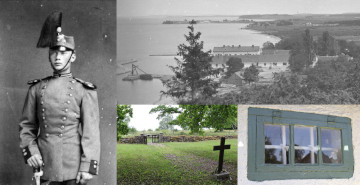
The area at the foot of Omberg, which is designated as the "Borghamn School building monument" in the government decision on the building monument declaration of 28 January 1993, is Vadstena municipality's largest and oldest building monument of an industrial nature. In addition to 22 buildings, the entire harbour, the Bocka cemetery with the pastureland, and the dog graves at the entrance are also included in the monument.
The harbour and original harbour buildings were built by the Göta Canal Company. The appearance of the buildings today, however, is mostly characterised by Borghamn's time as the work station of the Crown Labour Corps (1842-1894).
The area is best known for the Lanthushållsskolan, or later Borghamn School, which began operations in 1923 and ended as an upper secondary school in 1997. Then a hostel business was established, and as of October 2018, "Borghamn Strand" is housed here.
Since 2023, the building monument is listed as a working life museum.

